Key Takeaways
- Venues that try to offer something for everyone usually end up doing everything at an okay standard, and okay does not survive
- An exceptional product gets you talked about, but it does not fill the room on its own. Margan taught me that
- Most new owners never run the numbers that matter: average cheque, wage cost, food cost ratio, and whether the business survives a 10% drop in covers
- If someone else already does what you do, it is not unique. You need a Strategic Competitive Advantage, and you need to be able to say it in one sentence
- The Coast's booming population is an opportunity, not a guarantee. The cost of living crisis is sitting at every table
Once a week, without fail, I think about the customer at Fawk Foods in the Hunter Valley who ordered a half skim, half soy, half strength latte from me.
We made it. It was awful. It was always going to be awful. But the real problem was not the drink. The real problem was that nothing about the offering ever said no.
That order could exist because the menu, the counter, and the whole business was set up to offer a bit of everything for everyone. And when you are everything to everyone, you end up handing over a lukewarm compromise in a takeaway cup and calling it service. This is how the industry is, and it's okay if it's a weak, skinny soy latte, not your business model.
Most hospitality businesses fail the same way that coffee failed. Not through one big mistake, but through a hundred small yeses that should have been nos.
Everything for everyone is a menu for no one
Walk into a struggling venue anywhere on the Coast and you will usually find the same thing. A menu that runs three pages. A coffee offering, a cocktail list, a kids menu, a parma night, a seafood section, and a vegan option added because someone asked once.
None of it is bad. All of it is okay. And okay is the most dangerous place a hospitality business can sit, because okay gives nobody a reason to come back, and nobody a reason to tell their friends.
I have worked in cafes and I have worked in fine dining, including EXP. in the Hunter Valley, a restaurant that understood this completely. EXP. did one style of food at one standard and made zero apologies for it. You did not go there for a big menu. You went there because nobody else could give you that experience.
That is the first decision, and most owners never consciously make it. Pick the one thing you can do better than everyone around you, then build the entire business around protecting it.
An exceptional product still has to fight for every booking
At Margan, a destination winery and restaurant in the Hunter, I led the marketing for a product that was about as good as regional dining gets. Estate-reared lamb. Sustainable wine and food practices. A story you could not fake, because it was growing in the paddock next to the dining room.
The product drove the bookings. But it needed more, because the product had one problem it could never cook its way out of. Location.
Every single booking had to justify a drive. The story, the sustainability, the provenance, all of it existed to answer one question in the customer's head: why would I travel for this? Great food alone was never a complete answer. The story had to carry people the last fifty kilometres.
Here is why that matters for the Coast. Your venue has a version of the same problem even if you are on the main strip in Terrigal. The customer is always weighing you against staying home, and staying home has never been cheaper or easier. Your product gets them interested. Your story and your offer get them off the couch.
If you cannot articulate why someone would pass three other venues to reach yours, they will not.
The numbers most owners never run
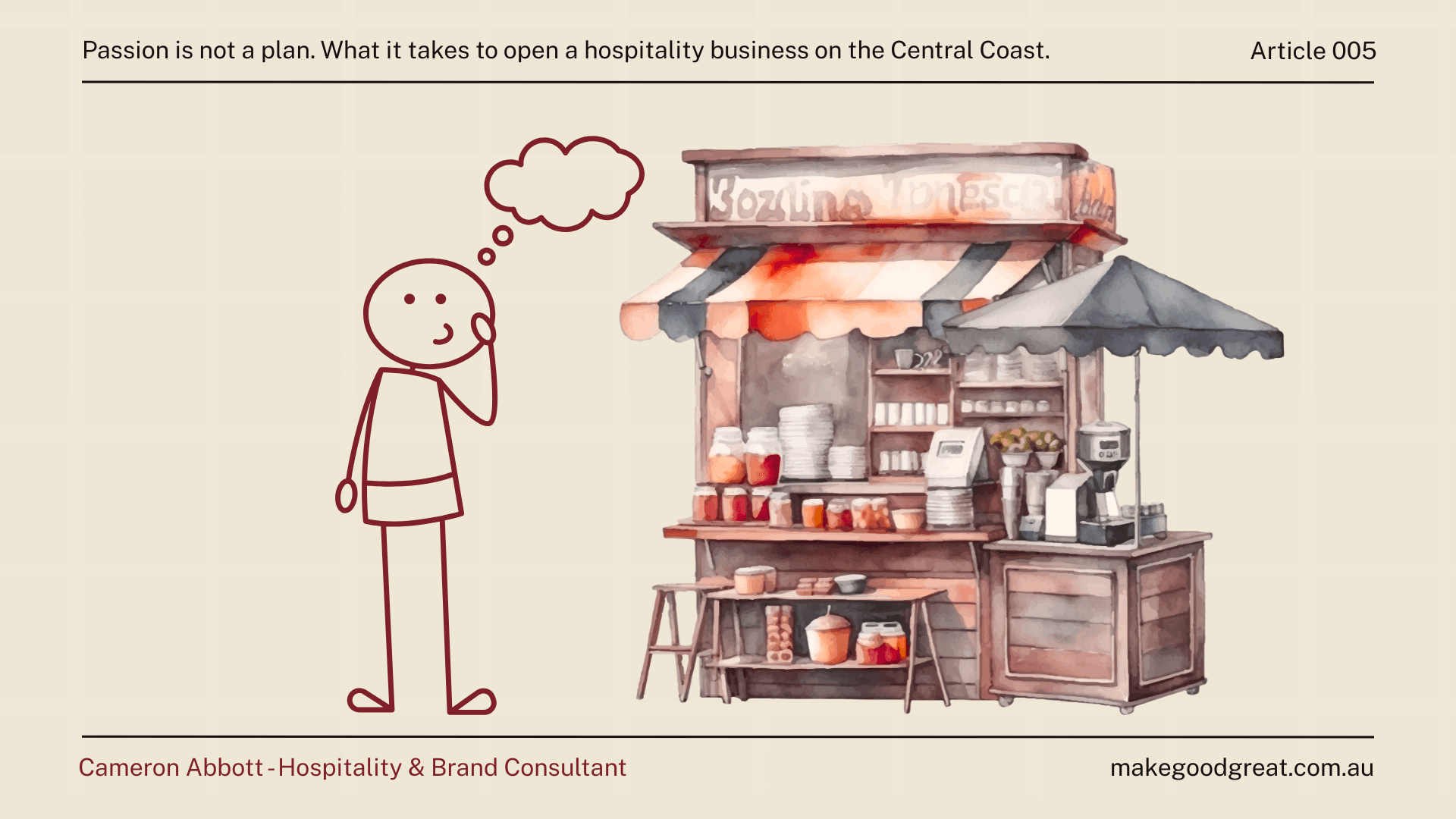
Passion covers the fit-out, the menu, the playlist, and the Instagram grid. It rarely covers the spreadsheet.
Before opening, you should know your target average cheque, your wage cost as a percentage of revenue, and your food cost ratio. Not roughly. Actually. These three numbers decide whether the business works, and I have watched experienced operators get them wrong.
There is a trap here that catches people who learned hospitality inside big venues, and I say this as someone who worked in major hotel food and beverage operations. Hotels and chains can bundle their offering. The rooms are where the revenue is, so the restaurant can run cheaper, carry thinner margins, and still make sense for the business. The food is there to support something bigger.
Your standalone cafe in Ettalong does not have rooms upstairs. Every dollar has to come across the counter. If your business model quietly assumes hotel economics, margins that only work when something else is carrying the load, you are planning someone else's business.
Then run one more test. If covers drop 10%, does the business survive? Not thrive. Survive. If the answer is no, you do not have a business plan, you have a best-case scenario.
If someone else does it, it is not unique
When I sit down with a client, this is where we get a bit theoretical, because the theory here is worth it.
The question is simple. What is your Strategic Competitive Advantage? What does your business do that competitors cannot easily copy, that customers actually value, and that you can sustain over time?
Does someone else nearby do it? Then it is not unique. A nice fit-out is not an SCA, it can be copied in a renovation. Good coffee is not an SCA on a coast full of good coffee. Friendly staff, local produce, water views. All good things. None of them an advantage on their own, because your competitors can claim every one of them.
If you cannot name your SCA in one sentence, we need to talk before you sign anything. Because without one, the fallback position is competing on price, and unless your costs are structurally lower than everyone around you, competing on price is a slow way to lose.
Unique offer or cheaper costs. If you have neither, you are hoping. Hope is lovely. It is not a strategy.
What I would tell a mate signing a lease tomorrow
Do not open the same business as your neighbour. The Coast does not need another venue doing what the place two doors down already does well. Second place in a suburb is a losing position.
Do not run one service period and expect the rent to work. Rent is charged seven days a week, twenty-four hours a day. A venue that only makes money four hours a day on weekends is paying full price for empty hours.
Do not offer a range of things that are only okay. That is the half skim, half soy, half strength latte as a business model.
Now the other side. Do one thing really well, better than anyone else within driving distance, and let it be the reason people come. Build a great support network and team early, because hospitality will test you and the operators who last are never doing it alone. And open something you are passionate about, because the hours are long, the margins are thin, and passion is the only thing that gets you through week forty.
Notice passion comes last. It belongs on the list. It just cannot be the whole list.
The Coast is an opportunity, not a guarantee
Here is the good news, and it is real. The Central Coast food offering keeps expanding and keeps getting better. The population is booming. People who moved up from Sydney brought their dining expectations and their dining budgets with them. There has never been a better moment to open something great here.
But the cost of living crisis is sitting at every table you serve. Customers are cutting discretionary spending, and eating out is the definition of discretionary. The venues that survive tight years are the ones that gave people a specific reason to keep coming, not a general one.
That is the whole argument, really. Passion opens the doors. A clear offer, honest numbers, and an advantage nobody nearby can copy is what keeps them open.
Thinking about opening a venue, or trying to work out why yours has gone quiet? Let's chat.