Key Takeaways
- The gap between what your marketing promises and what a guest actually experiences costs you more than poor marketing ever could.
- Spinning an operational compromise as a feature does not work. Guests arrive with the framing you gave them and judge the reality against it.
- The access gap is just as damaging as the experience gap. A great product behind a barrier the marketing does not acknowledge is still a broken promise.
- Most requests for more marketing are actually requests for more sales. The real blockers are usually price, operations, reviews, or access, not awareness.
The guest walks in. They have paid a premium rate. They have seen the photography. They have read the website.
Then someone at the front desk tells them the restaurant is in a different space this month.
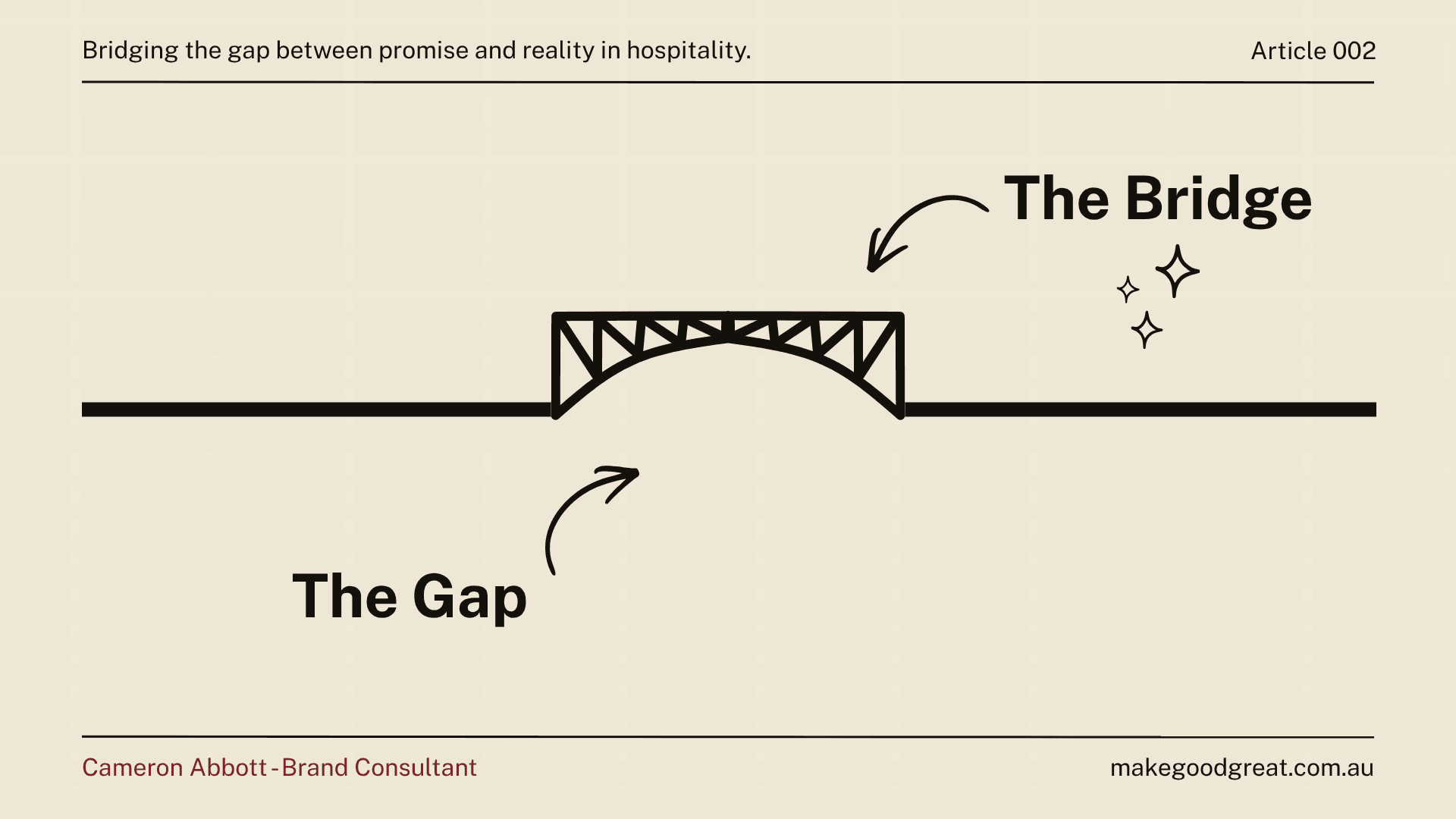
That moment, the few seconds between what they expected and what they are looking at, is where your marketing budget goes to die.
The promise is the easy part
Most hospitality businesses are good at articulating what they offer. The website looks right. The photography is strong. The copy hits the right notes.
The problem is the gap between what the marketing says and what the operation delivers. Not on a bad day. On a normal Tuesday.
I spent several years leading teams in hospitality before moving into marketing. The gap between those two worlds is not something you read about. You feel it every service, every check-in, every time a guest's face says something their words do not.
The complaints that stuck with me were rarely dramatic. A menu priced past what the food justified. An experience that looked right on the website and felt wrong in person. Small things on paper. Not so small when someone has paid a lot to be there.
Spinning a compromise makes it worse
The situations that created the most damage were not the ones where something went wrong. They were the ones where something was known to be compromised, and the response was to dress it up rather than manage it.
A temporary change to a dining offering, for example. That kind of thing can be handled simply. A short email before arrival. Clear, honest, no drama. Something like: we have made a temporary change to how we are operating. Here is what to expect.
What tends to happen instead is closer to spin. The compromise gets framed as something special.
Guests arrive with that framing and judge the reality against it. The disappointment is worse because the expectation was raised, not managed. The floor staff absorb the gap every service. That grind builds resentment fast, and it flows outward.
The instinct to make a compromise sound intentional is understandable. Nobody wants to lead with a problem. But guests are not naive. They know the difference between a deliberate experience and a workaround. Telling them it is special when it clearly is not does not protect the brand. It damages trust and leaves your team to clean up what the messaging created.
The gap does not always look the same
Sometimes it does not sit inside the experience at all. Sometimes it sits in the journey to get there.
A wine and food destination with a genuinely strong offer is a good example of this. The product is real. The experience delivers. But the location is not easy to get to. Limited accommodation nearby. No transport partnerships. No obvious path for a couple from the city to get there, stay and get back without it becoming an exercise in logistics.
The marketing made noise about the product. It did not solve the access problem.
That is still a gap. The promise is real. The barrier is real. And the marketing is doing half a job if it talks about the experience without addressing what stands between the guest and actually getting there.
Not every gap lives inside the venue. Some of them sit in the journey before a guest ever arrives.
What hospitality business owners actually want when they ask for more marketing
Most of the time, a hospitality business owner asking for more marketing is asking for more sales. Those are not the same request.
More awareness might be part of the answer. But the real blockers are usually sitting somewhere else. A price point that looks wrong on the Google menu before someone even clicks through. A star rating that has slipped below 4.5 and is quietly filtering out the customers most willing to pay. Opening hours that do not match when the target customer is actually free. A service issue showing up in reviews that pushes the acquisition cost higher with every new campaign.
Spending more on marketing to push people toward an operation that is not ready to convert them is expensive. The gap does not close because more people see it.
What closing the gap actually looks like
It starts before the brief.
Before any conversation about channels, budget or creative, the honest question is: what is the distance between what we are promising and what someone actually experiences when they show up?
Sometimes that distance is small. A few details. Better expectation management in the pre-arrival email. An honest look at what the reviews are actually saying.
Sometimes it is bigger. A product priced past what the experience justifies. An operation that cannot consistently deliver what the marketing has committed to. An offer that is genuinely strong but sitting behind a barrier the business has not bothered to remove.
The businesses that get marketing right tend to do one thing first. They get clear on what they actually deliver, not what they wish they delivered. Then they build the marketing around that.
More marketing is sometimes the answer. But it is rarely the first one.
If you are spending on marketing without seeing it come back, let's talk.