Key Takeaways
- FMCG pricing splits into two models: EDLP (consistent, predictable prices) and Hi/Lo (planned promotions). Most venues use neither deliberately.
- Loss leaders only work if you know what commercial behaviour they're supposed to trigger. If the answer is unclear, the special is just a discount.
- Supplier exclusivity deals are available to venues of almost any size. Most operators never ask.
- Consistent pricing on your staples builds more loyalty than any promotional campaign.
- Your margin position determines which strategy is actually open to you. Run the numbers before you commit to a direction.
- Psychological pricing and time-based pricing are tools most venues overlook. Both are worth understanding, even if you decide not to use them.
It's 35 degrees. You've had a big week. You walk past a pub you haven't been to before and the pull is immediate. Good fit-out, live music setting up inside, a chalkboard out front that someone actually put thought into. You go in.
You order a schooner.
$11.50.
You don't say anything. You pay it. But something shifts. Without meaning to, you're doing the maths. Your local charges $7.50 for the same beer. Still not cheap, but at least it feels fair. This place wants four dollars more, and it's been open five minutes. You find yourself glancing at the menu before you order another round. You're counting now, in a way you weren't when you walked in.
You probably don't go back.
Not because the beer was bad. Not because the vibe wasn't there. Because the price sent a message the rest of the experience didn't earn. And the pub has no idea that's what happened.
Here's the thing: $11.50 might have been defensible. Curated taps, a proper sound system, a room worth being in on a Tuesday. But the value was never established. The price arrived without context, and context is what makes a premium feel earned rather than arbitrary.
A pub in the Hunter Valley has had a $6 schooner for three years. Not a happy hour. Not a midweek deal. Just the price. Walk in on a Saturday night with a group and it's $6. Walk in Tuesday afternoon on your own and it's $6. Nobody asks and nobody thinks twice.
The owner didn't stumble into that position. He made a decision about what his venue stands for and held it. The regulars reward him for it. New customers come back because there's no surprise on the bill.
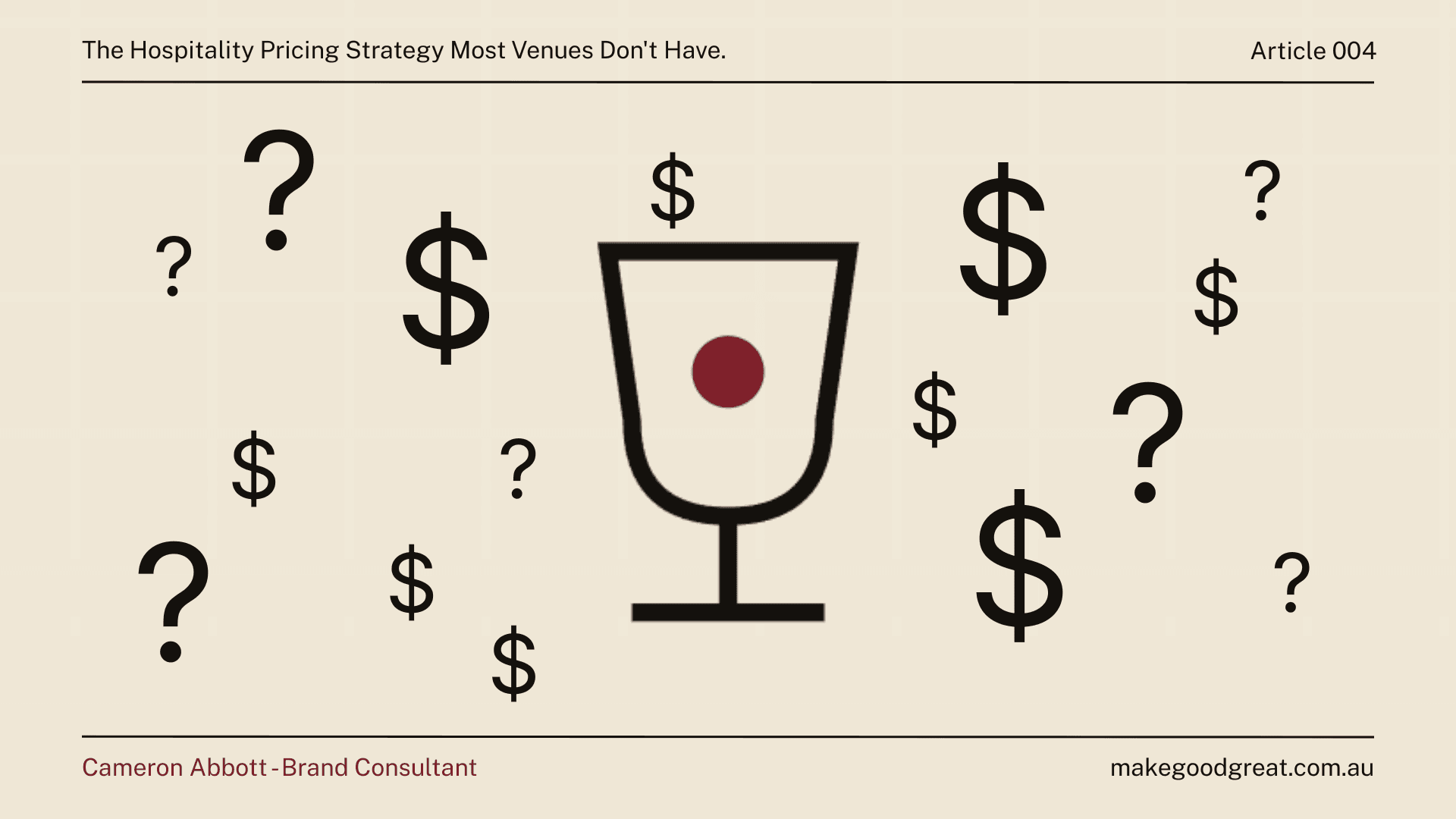
That's a pricing strategy. Most venues don't have one.
They have prices. A number on a menu arrived at by checking the competition, covering costs, and rounding up. That's cost-plus pricing, and it tells you the floor. It doesn't tell you whether your floor is right for the experience you deliver, or whether you're leaving money on the table by anchoring to cost when the market would bear more. The brands on the supermarket shelf figured out this distinction thirty years ago. Hospitality is still catching up.
Two pricing models, one decision
Fast-moving consumer goods runs on two distinct pricing philosophies.
The first is EDLP, or Every Day Low Pricing. This is how Aldi operates. How Costco operates. Prices are consistent and predictable, no sale required. Customers stop evaluating and start trusting. That trust, built over time through reliability, is the real commercial asset.
The second is Hi/Lo pricing. This is what Woolworths and Coles do. Regular prices sit at a certain point but are punctuated by promotions: half price this week, specials in the catalogue, loyalty discounts. The goal is to create reasons to visit at key moments, not to be the cheapest every day.
Both work. Neither is automatically better. But the brands that execute them well pick one deliberately and commit. They don't drift between the two based on what a competitor did last month or how Tuesday is tracking.
Most hospitality businesses drift constantly. The customer notices, even if they can't name why.
EDLP behind the bar
There's a venue in most towns that people just trust. You know what a schnitzel costs. You know what a schooner costs. You haven't looked at the menu in three visits because you already know. That predictability isn't an accident. It's the product.
That's EDLP. Not cheap. Not discounted. Consistently fair.
For a venue, this means building your core offer around a price point you actually commit to. Your house beer. Your house wine. A couple of staples. Not the lowest in the area, but a reliable price for the value you deliver. Over time, customers stop comparing you to other options because you've taken the question off the table.
It compounds. After a few years of consistent pricing on the things people order most, you're not selling food and drinks anymore. You're selling certainty. For a venue serving a regular local crowd rather than a tourist market, that's a real competitive advantage.
One detail worth folding in: $10.00 and $9.90 are not the same price. Some venues committed to EDLP use round numbers deliberately because they read as more confident and transparent. Others use charm pricing, $9.90 instead of $10, because it still shifts behaviour even on a bar menu. Either way, it's a choice. Make it on purpose.
Hi/Lo done right (and done wrong)
Happy hour is Hi/Lo. Thursday trivia specials are Hi/Lo. Long weekend bottomless brunches are Hi/Lo.
Done well, these give customers a reason to come in at moments when they wouldn't otherwise bother. They fill quieter trading periods, generate word of mouth, and bring in people who haven't tried you before.
Done badly, and this is most venues, they train customers to wait. If someone works out they can always get a cocktail for ten dollars on Friday night, they stop coming in Friday afternoon. If the Wednesday pasta special never goes away, Saturday bookings start softening because people know there's always a deal if they wait.
Woolworths rotates its half-price catalogue items constantly. The same product doesn't go on special every fortnight. The deal is real, but it isn't predictable. That's deliberate. The scarcity of the specific offer is part of what makes it work.
For a venue, that means your promotional strategy should look like a calendar, not wallpaper. Four to six real promotional moments a year, tied to something specific: a season, a local event, a new menu, a quieter trading window you want to lift. Different each time. Communicated clearly. Finished on schedule, not quietly extended because it's driving volume.
The most sophisticated version of Hi/Lo in hospitality isn't happy hour. It's time-based pricing: a Friday night price that reflects Friday night demand, and a Tuesday price that reflects Tuesday reality. Hotels have done this for decades. Uber does it in real time. A handful of venues are starting to apply the same logic to their drinks lists. Done transparently, it's not controversial. It just reflects what the market actually bears at different times of the week.
What a loss leader is actually for
Supermarkets price milk, bread, and eggs at or near cost. Not because they're generous, but because getting you through the door for milk means you're buying twelve other things whilst you're there. The milk is the mechanism. The margin comes from everything else.
Hospitality has its own version of this, though most venues don't think about it in those terms.
A meal deal that includes a beer is a loss leader. The kitchen breaks even on the food. The beer carries the margin. In the trade, operators track this as pour cost: the percentage of the sale price that the liquid itself costs. A well-run bar keeps it around 20 to 25 percent, which means even in a deal, the schooner is still making money. The real point is that the deal gets people through the door at 6pm on a Wednesday when the room would otherwise be half empty. Those same people buy another round, stay for dessert, and book again. The cheap entry point starts a commercial relationship that pays off several times over.
Cafes work this way too. A $5 coffee isn't where the money is. But it brings someone in five mornings a week, and by Wednesday they're also buying a toastie and occasionally a bag of beans to take home.
What matters is whether your loss leader is working as a mechanism or just as a discount. If you're running a $9 burger special and people are eating the burger and leaving, that's not a loss leader. That's just a loss. Start with the margin on the entry product itself. If you haven't run those numbers recently, the margin calculator is a quick way to do it. Then check what behaviour is actually happening after the entry point, and whether it matches what you intended.
The supplier conversation most venues never have
This is where the real leverage sits.
FMCG brands and major retailers have negotiated exclusivity arrangements for decades. Stadium pouring rights. Soft drink exclusives in fast food chains. One beer family on tap, contracted at volume. The venue commits to volume, the supplier commits to pricing, and both sides get something they couldn't get otherwise.
That same logic applies to independent operators more than most of them realise.
A venue that commits to running one brewery's full tap range has something valuable to offer that brewery: guaranteed volume and distribution. In return, you can negotiate meaningfully better wholesale pricing per keg, priority support during busy periods, co-branded tap assets, and sometimes direct investment in venue events or marketing from the brewery's trade budget.
The same conversation works with wine. A restaurant that commits to a regional winery for its house pour, and puts that story on the menu, has a negotiating position most venues never try. Instead of buying in small quantities scattered across a dozen different labels at close to retail pricing, you're buying volume from one producer at producer pricing.
Coffee, spirits, milk suppliers, smallgoods. Most categories where there's a real supplier relationship will respond to this. Suppliers want committed, reliable distribution. Venues want better margin. The deal is usually there. It just requires someone to start the conversation, which most operators never do because they assume it doesn't work that way for businesses their size.
It does.
When you bring your cost down through supplier commitment, you've got two options. You protect the margin, which in the current operating environment is worth a lot. Or you pass some of it through to the customer as a sharper price on your house beer. A $6 schooner instead of $8 is an EDLP move, and your pour cost stays healthy because you've improved what you pay at the tap. That's what makes it sustainable rather than a promotion you'll quietly walk back in six months. If you want to model what a cost shift like that does to your margins, the margin calculator is a good place to run the numbers.
Make the decision
Most venues haven't chosen between EDLP and Hi/Lo. They drift, and the customer ends up confused about what the venue actually stands for commercially. That confusion costs more than a mispriced schooner.
Start with your staples. Apply EDLP logic to the things people order most often: house beer, house wine, two or three high-volume menu items. Hold the price, don't discount them, and let the consistency build over time.
Save Hi/Lo for a real promotional calendar. A handful of moments a year, tied to something specific, communicated in advance, finished on schedule.
Be straight with yourself about your loss leaders. Know what behaviour you're trying to produce and check whether it's actually happening. If it's not, change it.
And have the supplier conversation. Start with the two or three categories where you spend the most. Frame it as a volume commitment in exchange for pricing consideration. Most suppliers will engage.
Most venues think about pricing when they open, and then again when they're losing money. The brands on the supermarket shelf think about it every week.
That's the gap. Not the prices. The intentionality behind them.
The question isn't whether your prices are right. It's whether you have a hospitality pricing strategy at all, and whether you know what it's trying to do.
If you want to work through what that looks like for your venue, get in touch. It's usually a short conversation.